
Center for Creative Leadership – “15 Tips for Effective Communication in Leadership”
Inspiring the Passion and Potential within others to contribute to the Greater Good
We all know that there are costs associated with employee turnover – reduced productivity, increased stress on remaining team members, loss of organizational understanding, time devoted to interviewing and onboarding replacements, etc. – but other than fees for job boards and recruitment services, those “costs” never require you to make a payment. The losses are in work not getting done and income not being realized, not in money leaving your bank account.
But what if that changed? What if every time a Team Member leaves you had to sit down and write a check? $2500 for lost productivity until a replacement is found and brought up to speed. $1500 for the customers who start to go someplace else because they’re no longer greeted by name when they come through the door. $5000 for the employee who is looking for another job because they are now trying to do the work of two people.
Would you start to pay closer attention to Team Members’ Engagement and Morale? Would you start to have more frequent conversations about career goals and opportunities? Would you (could you?) put more effort into getting to know your Team Members and building real relationships with them?
If your electric bill goes up, you immediately start to look for ways to reduce it. If the costs of repairing and replacing equipment get too high, you look at improving your care and maintenance programs. You shouldn’t have to receive an invoice for “Cost of Jill Leaving” to begin to look at turnover the same way.

For Leadership Development Workshops to be successful you need to start with great content. But great content is just that, the start.
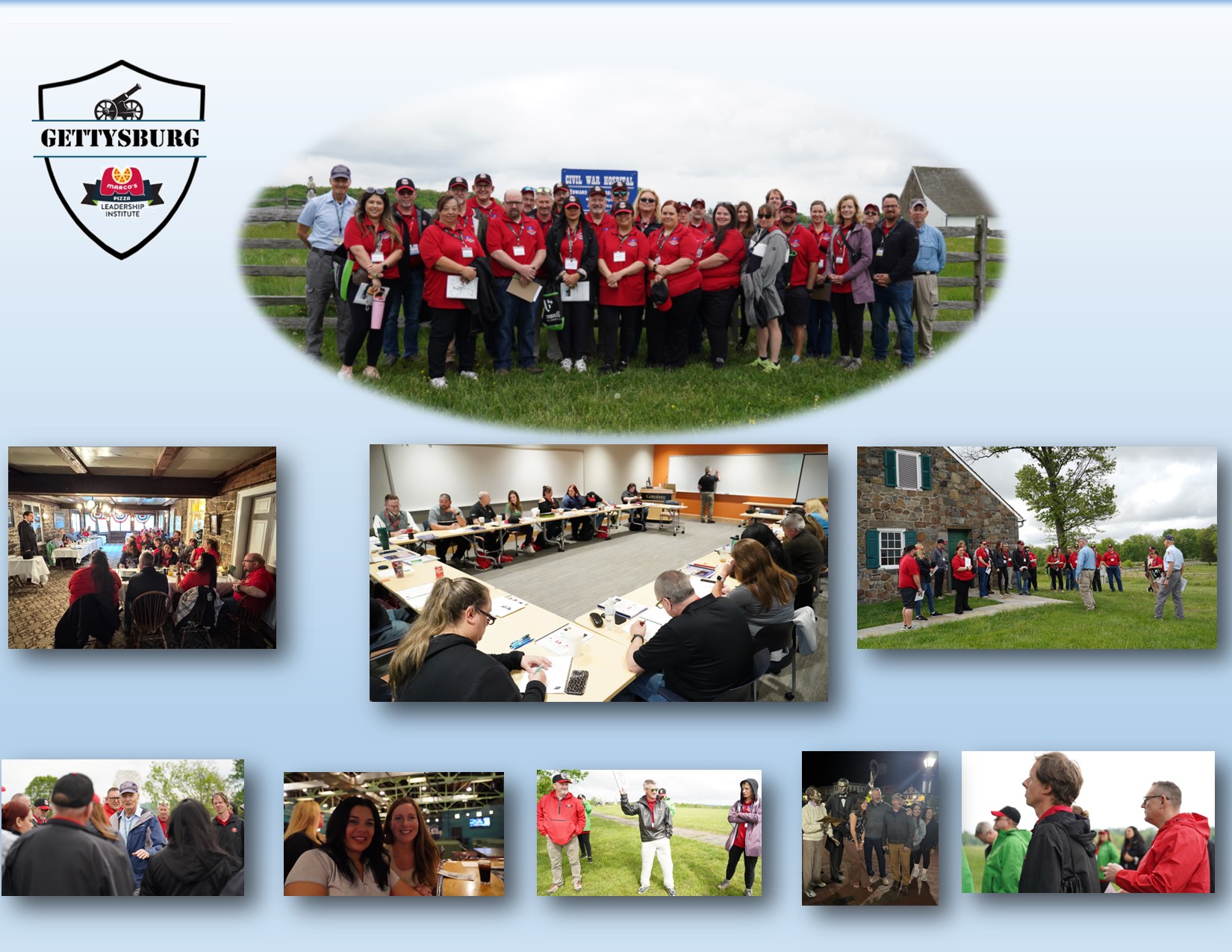
The foundation of the Annual Marco’s Leadership Institute Gettysburg Workshop is the world-class content and experience provided by Diamond6 Leadership & Strategy. Following their model of “Learning from the past to prepare for the future”, participants are presented with the events of July 1863 and then asked to examine and apply the modern day leadership lessons based upon that history. They experience that learning in one of the most historic and important settings in the United States… the impact of Lincoln’s Gettysburg Address is multiplied ten fold when you are standing within yards of where the Address was delivered.
But as I said, the Battlefield component of the workshop is the foundation.
Leadership Development should also be an “experience”. To paraphrase one of my favorite authors, Priya Parker, a chance “to ‘Gather’, to create meaningful and memorable experiences.”
The MLI Gettysburg Workshop is purposefully designed to bring together a diverse group of individuals – Franchisees, Marco’s Pizza (Marco’s Franchising, LLC) Team Members and Senior Leadership, and Business Partners – and provide them with the opportunity to get to know, and to better understand, one another. The fact that they are doing that relationship building (and hopefully having fun) in some incredible venues and locations only adds to the experience.
Finally, the ultimate value of any leadership development workshop or program is measured by what happens after the event; putting education into action.
MLI Gettysburg Workshop Participants spend a full day working on how they will apply the lessons that they learned on the Battlefield. They focus on self-awareness through the use of the Predictive Index and Emotional Intelligence and Leadership Style assessments, increase organizational and Team awareness through structured analysis, and finally, using the Logic Outcome Model, begin to develop both Organizational and Personal Strategic Visions.
We packed a lot into 3 days, but we’re confident that the participants had an experience that will take them to the next level on their Leadership Development journeys, fulfilling our Mission of “Inspiring the Passion and Potential within others to contribute to the Greater Good.”
One of the most often asked questions: What’s the difference between Leadership and Management?
If I’m in a rush, the answer is, “Management gets you through today; Leadership gets you to tomorrow.”
It’s quick, it’s concise, and it isn’t wrong.
Leadership is about creating and communicating a strategic vision. It’s about putting together, and sustaining, a team that will be productive for the long haul. It’s about nurturing a curiosity that will insure you organization is riding the wave, not getting wiped out by it. Ultimately, Leadership is about the future.
Management on the other had is primarily focused on day-to-day and week-to-week results. It’s about scheduling and production and controlling costs. Management provides the solid business operations that make planning for the future possible.
What makes the Leadership vs. Management question tricky is that when it comes to individuals, there often isn’t a clear line between the two: Most Leaders have solid Management skills and most Managers, especially the very effective ones, have strong Leadership skills. The most important distinction is where they focus the majority of their time and energy. A strong Leader can’t ignore day-to-day operations but they can’t become so bogged down in the “now” that they aren’t building for the future. Similarly, a strong Manager needs to be able to think long-term but they can’t spend so much time doing so that day-to-day operations slip.
A much more detailed explanation from one of my favorite authors/thinkers:
Back in the spring the Marco’s Leadership Institute hosted a 1/2 day virtual Business Acumen workshop. During one of the breaks, the facilitators commented on how much fun our group was having – there was joking and teasing about which team was going to “win” and, in general, we were having a good time – and how much fun we were to work with.
In the 30 + years that I’ve been involved with leadership development, I have always believed that because the responsibilities of leadership are incredibly serious, and that leadership development is something “extra” that we’re asking people to add to their already busy lives, the experience of leadership development should be, as much as possible, fun. I really don’t understand not making that a goal.
Purely by coincidence, at about the same time as the workshop, my wife Cheri Rinehart had given me her copy of Dave Raymond ‘s book “The Power of Fun!” (Dave had spoken at PACHC’s Annual Conference; she knew I’d enjoy the message and, as a Philly sports fan, the Phanatic stories.) In addition to being a great read, it drove home the importance of making FUN a priority!

It’s Not Versus
“…leadership and management are two distinctive and complementary systems of action. Each has its own function and characteristic activities. Both are necessary for success in an increasingly complex and volatile business environment.”
______________________________________________________________________
“Management is about coping with complexity. Leadership, by contrast, is about coping with change.”
__________________________________________________________________________
“What’s crucial about a vision is not its originality but how well it serves the interests of important constituencies—customers, stockholders, employees—and how easily it can be translated into a realistic competitive strategy.”

Those who know me won’t be surprised that I’m not a big proponent of New Year’s Resolutions.
It’s not that I don’t believe that eating healthier, exercising more, quitting smoking, etc. aren’t good things – they absolutely are – it’s just that taking them on as part of a grand “New Year, New Me” plan is fraught with obstacles and opportunities to feel dejected about your progress. In fact, the challenges are so large that one study found that 23% of people who make New Year’s Resolutions abandon them by the end of the first week and almost half have given up on them by the end of January.
So, with that in mind, I’m not going to suggest you make resolutions for 2024. Instead, I’m going to strongly encourage you (just short of begging) to make a personal/professional development “To Do” list. The biggest difference is that I don’t care if you start crossing the items off on January 1st. You can start today, or you can start 6 months from now; the most important thing is that you start.
Pick one skill that would benefit you in your current job, or get you ready for your next position, and make a plan to improve it. Is there a software program that you wish you were better at using? Would your work life be easier if you had a better understanding of finance and accounting? Identify something that you would like to be better at and start working on it.
Flower arranging. Woodworking. Playing the guitar. Learning a new language. What’s that “thing” that you’ve always wanted to learn how to do? Sign up for a class, watch some videos, ask someone to teach you. Learning fires up different parts of the brain (combining it with a skill that requires physical activity is even better) and developing new skills creates a sense of accomplishment and confidence.
Volunteer at your local food bank or library. Help your elderly neighbor with their yardwork. Find something to do for others that is meaningful to you. Kindness creates a sense of belonging and purpose and makes the world a better place. As an added bonus, volunteering is a proven way to build your personal and professional networks and develop leadership skills.
Make time to take care of yourself. It doesn’t have to be a lot of time, and often it can’t be. Even if it’s just 15 minutes for a walk, or to listen to your favorite music, or to really enjoy your lunch, make sure you are devoting time to you.
Strong relationships are the foundation of both personal and professional well-being. No one can be, or should be, expected to do everything on their own. I’m not talking about “networking” but about developing stronger relationships based upon really understanding who the other person is. Over the next few months, identify at least one person from each of the following groups and make an effort to improve/develop the relationship you have with them.
A couple of final thoughts…
Take some time to think about what you’d like your life to look like a year from now. The journey is much easier if you have an idea of where you want to go.
Progress is progress. Starting the items on the above list can be even more important than completing them.
I worked with a recruiter who always said that starting a new job should “feel like your birthday”. But far too often, we take the excitement and energy that comes with starting a new position and turn it into a stack of forms and a cursory introduction to your co-workers before jumping into the to-do list.
Successful onboarding, the kind that maintains that excitement and turns it into long-term engagement, takes a plan that goes well beyond the first day or week.
In this article from the Association for Talent Development, Andrew Joly lays out what a great Onboarding Plan should include.

For several years I had the honor of attending the Length of Service Recognition Dinner for a non-profit that, for a whole host of reasons, I think sets the Gold Standard for Organizational Excellence.
Their general guideline was to spend $100/year of service for gifts for the employees who were being recognized: 1 year = $100, 5 years = $500, 10 years = $1000, etc.
Whenever I would tell that story, especially when working with other non-profit organizations on identifying ways to reward and recognize their employees, the response was almost always the same; “It must be nice to have that kind of money to throw around. We could never afford to do that.”
Then I would break down the numbers…
$100/ year = $2 / week = 40 cents / day = 5 cents / hour!
Five cents per hour to say “thank you” to your most dedicated team members and recognize them for their commitment.
But more important than the cost of the gifts was how they were selected. The CEO would personally select, and in many cases shop for, the gifts based upon what she knew about the individual. The Elvis fan got a weekend trip to Memphis. The fishing fanatic was given a chartered fishing trip that included his family. The doll collector received a custom ordered, one-of-a-kind, hand made doll. The gifts weren’t special because of the cost; the gifts were special because they reflected how much the CEO knew and cared about her team members. (Compare that to my wife’s former employer who for her 15th anniversary sent her a catalogue with instructions to pick anything from pages 32 to 37. The globe she decided on is beautiful, but there isn’t anything “personal” or, for the most part, “meaningful” about it.)
So, forgetting about the “cost” (at least for the moment) what can you do to show your team members how much you “value” them? More flexibility in scheduling? Surprising them with lunch? Replacing the generic Big Box Store gift card with one to their favorite restaurant? Or, as crazy as it sounds, budgeting the extra 5 cents per hour and taking the time to get them something that shows you know them and value their contributions?
Several years ago I was reading a book on effectively delivering your message and two key points jumped out, and stuck:
1> Every time you present you should be “acting”. You’re not being fake or even necessarily performing, but you are acting as the best version of yourself for what the situation and the audience requires.
2> Every time you communicate with someone you are “presenting”, whether it is from a stage to hundreds of people or one-on-one at the coffee machine (or over Zoom.)
In her latest newsletter, award winning speaker and author Bridgette McGowen explains how to apply her presentation approach to what is probably the predominate thing on every leader’s calendar – the recurring meeting.
https://www.linkedin.com/pulse/meetings-presentations-too-bridgett-mcgowen-xaotc/
Click either link below to get started:
https://apply.expandshare.com/marcos
https://share.voomly.com/v/5Tcyul9Cl
Favorite Pizza Chain
In an industry rife with competition, quick-service restaurants are pulling out all the stops to turn patrons into loyal customers.
Diners aren’t just looking for quality food or speedy service, they want both. Chains that are able to adapt to changing consumer demands are better equipped to keep customers walking in the front door.
Market Force Information is out with a new set of restaurant rankings culled from the responses of more than 11,000 people and aggregated into a composite loyalty index that measures satisfaction with the food quality, service, value and restaurant experience, among other things.
The company averaged each chain’s score to determine which had the highest loyalty rating.
Here’s what Market Force found:
Marco’s Pizza

In a crowded field of pizza chains, Marco’s Pizza came out on top. The chain scored 75 percent on the loyalty index, edging out Papa Murphy’s, which held the top spot for three straight years.
Marco’s Pizza received strong ratings in food quality, atmosphere and cleanliness.
Close competitors were Papa Murphy’s with a score of 71 percent and Pizza Ranch, which scored 64 percent.
The lowest ranked pizza chains were Pizza Hut, Little Caesars and CiCi’s pizza.
http://http://www.toledoblade.com/Food/2015/08/30/Pizza-U-rises-to-the-occasion.html

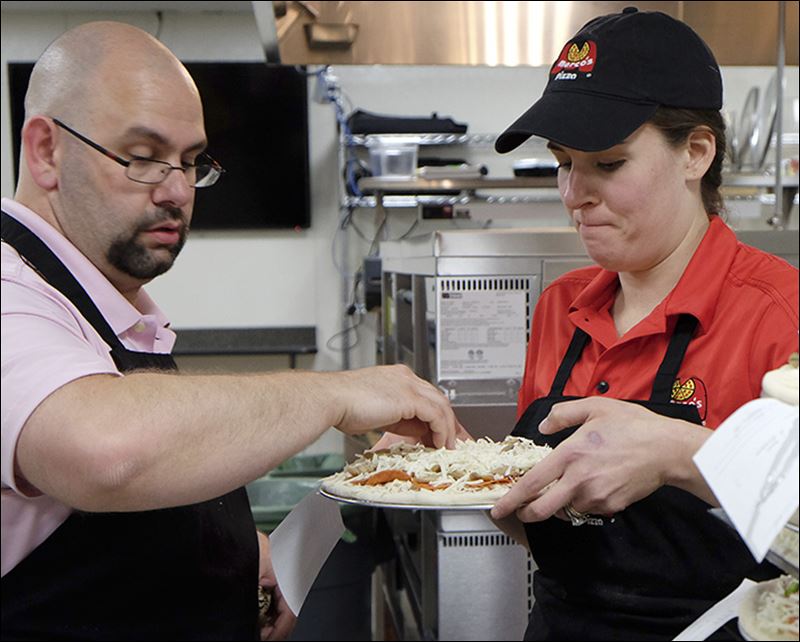
Trainer Chuck Blevins of Lincoln Park, Mich., spreads cheese on a pizza held by Sara Ragsdale of Charleston, S.C., in Marco’s new test kitchen on Monroe Street. Marco’s was named the second-fastest growing chain in the nation.
Ed Alimi flew this month nearly 2,000 miles from his San Diego home to Toledo to learn how not to make a pizza.
He could have stayed home, bought a pie from a local pizzeria, ate it, and learned absolutely nothing. But as a new franchisee of Toledo’s Marco’s Pizza, Mr. Alimi is keen to make his budding pizza franchise succeed.
“That’s the whole idea of being at the corporate office, he said. ”They teach us the best way to make a pizza and how not to make a pizza.”
His Toledo training included a week at “Marco’s Pizza University,” a $500,000 training kitchen and research and development facility that the pizza company opened six months ago at its headquarters at 5252 Monroe St.
The test kitchen and R&D center is used for many purposes, including testing new products, said Bryon Stephens, president and chief executive officer of Marco’s Franchising LLC, which operates Marco’s Pizza. “But the biggest reason for having it is we use it as a training facility for all our franchisees coming in,” he said.
Until last year, Marco’s gave its new franchisees a week of classroom time at its headquarters to cover business issues, then took them to a local store to practice making pizzas and other food items.
“That was OK, but it didn’t provide the most optimal training period,” Mr. Stephens said. “You had to contend with the business that was coming in the store. It was a really slow way to educate people, and it was stressful.”
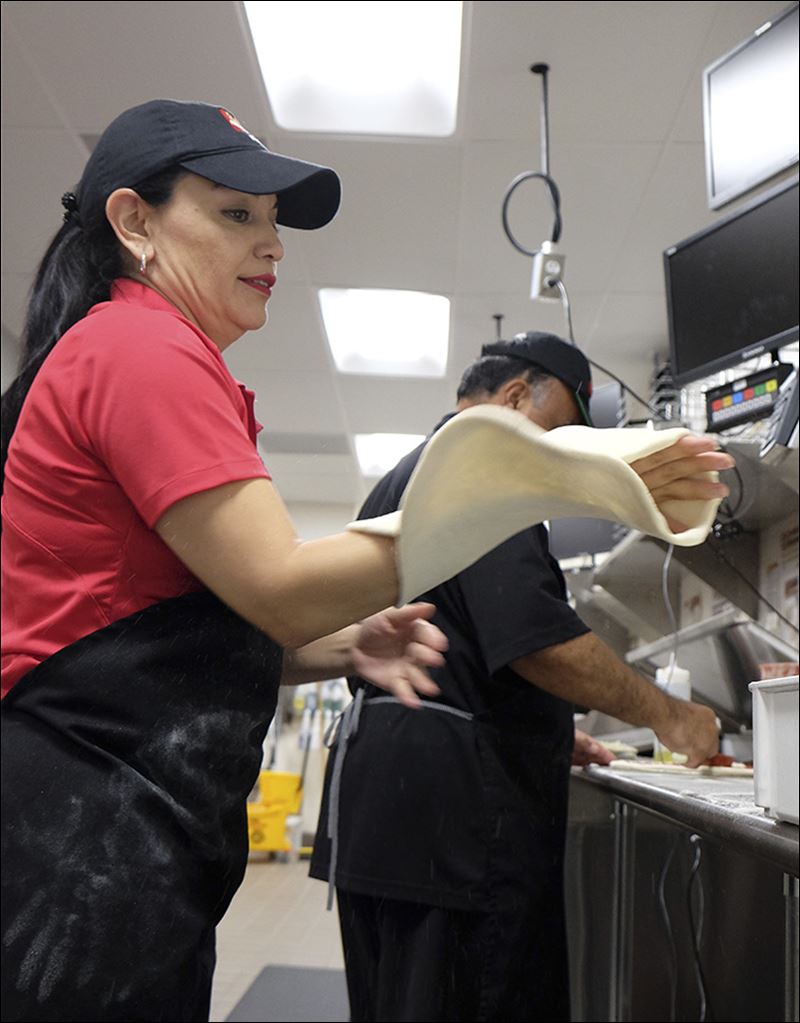
Delmy Lopez of Smyrna, Ga., stretches dough for a medium-sized pizza. Behind her, Ed Alimi of San Diego, applies sauce to a crust.
With the 3,500-square-foot test kitchen, franchisees can learn the process “without being under fire,” he said.
Marco’s, which had $338 million in sales in 2014, decided that its big push to add franchises spurred the need for the kitchen training site.
Privately held Marco’s, which began in 1978 and recently was named the second-fastest growing large chain in the country by the Nation’s Restaurant News, has 640 stores in 35 states and the Bahamas, including 141 restaurants added in the last year. It says it is on track to quadruple its store count by 2022.
It plans to open 150 stores by the end of this year, and recently it finalized deals for 400 new stores in India over the next 10 years and 40 stores in Puerto Rico over the next nine.
Four years ago it was adding 20 to 40 stores a year, but now is doing 150 to 175, Mr. Stephens said.
“We started to realize that in order to have 10 to 12 people in a training class at one time, to keep that one-on-one element, we needed to do a reboot,” the chief executive officer said.
Lynn Liddle, a Domino’s Pizza executive who is chairman of the American Pizza Community, a lobbying organization whose members include most of the nation’s largest pizza chains — but not Marco’s — said it is common for pizza companies to have test kitchens.
Such test kitchens are used to “test recipes and operational aspects of our products, conduct training or demonstrations,” Ms. Liddle said.
“Pizza is a handmade, fresh product in many cases and requires the same care and artistry as any food recipe would,” she added.
Marla Topliff, chairman of the National Restaurant Association’s Pizzeria Council, said of a test kitchen, “It gives [franchisees] the opportunity to slow down and learn things the right way.”
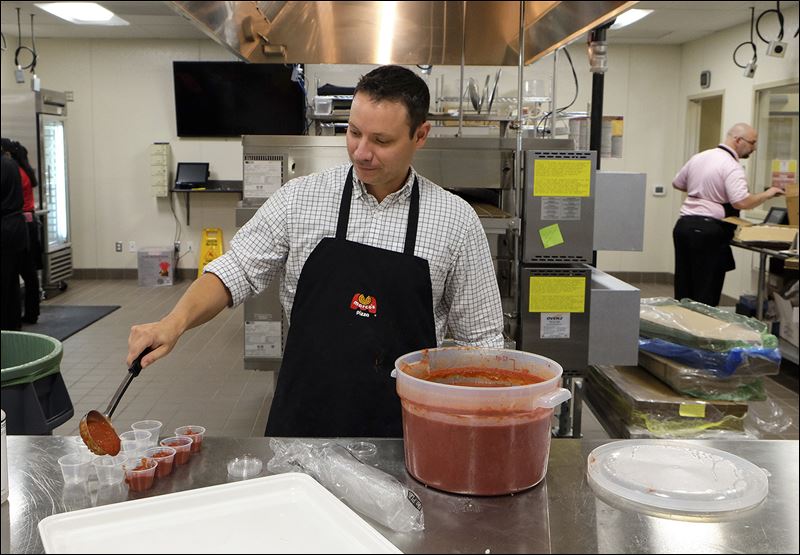
Robert Tankoos of Charlotte ladles marinara sauce into small cups to accompany cheesy bread orders. Mr. Tankoos, who is originally from Toledo, and the other franchisees put their skills to the test at Marco’s Pizza corporate office.
“If you’re a larger chain like Marco’s, this is an excellent move, because when you’re bringing in franchisees you need a place to train them according to to your recipes,” said Ms. Topliff, president ofRosati’s Pizza in Chicago. And, she added, it is cheaper than sending out training teams.
“Plus, it’s very difficult to train someone out in the field,” she said. “We do our training in our main corporate store. Frankly, the kitchen isn’t large enough. It’s just too small, plus you want the best possible training setting you can get,” she said.
As a bonus, a test kitchen gives a chain the place to develop new recipes. “Recipes can take a long time to develop. It could take up to several months,” Ms. Topliff said.
Mr. Stephens said Marco’s shows franchisees not only how to make the perfect pizza, but how pizza-making can go wrong.
“We’ll have them purposely make dough wrong on occasion so they can see what would happen without a particular ingredient, what happens to our dough without the proper water, what happens when the water is too warm or the water is too cold,” the CEO said. “It’s one thing to know what looks wrong in theory. This way they’ll know what it looks like in practice.”
Not only does the training help with quality assurance, he said, it also means the trainees see something happen, such as a pizza crust that doesn’t rise properly, and then they will know what to do, something maybe they wouldn’t realize if they had previously seen it.
Franchisees get a certificate for completing Pizza University training, which includes a week of classes, followed by six weeks in the field at a franchisee in their home region, then a final week in the test kitchen.
“They come back here so we can thoroughly test them,” Mr. Stephens said.
Mr. Alimi, a former IT specialist with the U.S. Department of Homeland Security, spent his six weeks at a store in Salt Lake City. There are only a handful of Marco’s Pizza stores in California, he said.
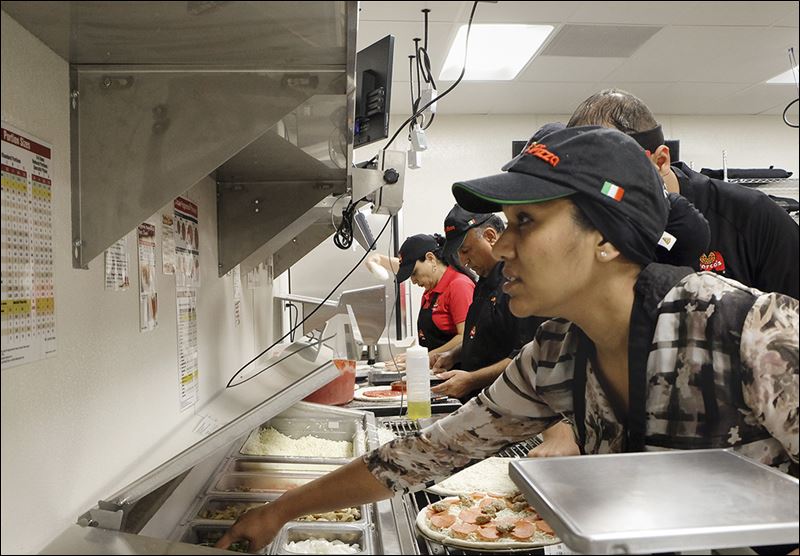
Iffy (cq) Momin (cq), of Decatur, Alabama, checks how much green pepper to put on a pizza. Marco’s Pizza franchise trainees polish their skills in the expanding pizza business’ new test kitchen in Toledo, Ohio on August 19, 2015.
In fact, Mr. Alimi is the first franchisee in San Diego. When he went looking for a career change and decided on a food franchise, he and his family had to drive two hours to Los Angeles just to find a Marco’s pizza to taste.
“We did a test, and everybody likes it. It’s fresh, very fresh dough and ingredients. I’m sure everybody in San Diego is going to like Marco’s Pizza,” said Mr. Alimi, who paid between $300,000 and $500,000 for his franchise. Marco’s said that the average cost for one of its franchises is $350,000.
Besides training franchisees, The Marco’s test kitchen gives the company a secluded place to plan and test potential new menu items. Recently, two flavors of brownie desserts — a Ghirardelli Double Chocolate version and a S’mores version — emerged from the kitchen after some experimentation.
It also successfully designed three limited-time specialty pizzas in the kitchen — a spicy fresco pizza, a grilled chicken florentine, and a Roma meats pizza.
“Our desserts lineup is something that we look at on our menu mix all the time,” Mr. Stephens said. “But we’ll look … beverages, pizzas, salads, sandwiches, sides, breadsticks, and desserts.”
After testing new products in the test kitchen, they are tested with customers in one or two areas. Before, initial testing was done in stores, and the customers expected that product to be on the menu later, and it may have been scrubbed. Plus, in a test kitchen, there’s more confidentiality on new products, Mr. Stephens said.
And, the test provides a place to test out new equipment, something to improve the efficiency, checked out initially without affecting an operating store.
Contact Jon Chavez at: jchavez@theblade.com or 419-724-6128
Read more at http://www.toledoblade.com/Food/2015/08/30/Pizza-U-rises-to-the-occasion.html#wib3RfU6uGxihMYo.99
http://nrn.com/sullivision/why-training-more-important-marketing?eid=forward
Jim Sullivan is a keynote speaker at foodservice leadership conferences worldwide. His newest book Fundamentals is available at Amazon orSullivision.com. Check out his leadership video series at NRN.com. This article does not necessarily reflect the opinions of the editors or management of Nation’s Restaurant News.

What is the function of a business?If you answered, “To make money,” you’re wrong. The function of a business is to attain and retain customers. The goal is to make money.
As I’m sure you know, having a full dining room, bar or drive thru is no guarantee you’re profitable. Volume can hide a multitude of sins: Chefs over-order perishable goods; cooks burn food; servers underwhelm guests; bartenders break liquor bottles; patrons knock over glassware; busers drop china-filled bus tubs; dishwashers drop forks in garbage disposals; and drive-thru cashiers over-portion napkins, sauces and condiments. Full house? Awesome. But a lack of customer retention via effective training means you just lost money tonight.
Money spent on customer acquisition (advertising and promotion) can fill a restaurant, but money spent on customer retention (training and service) makes that restaurant profitable by transforming a single visitor into a lifetime guest.
So, if our function is to attain and retain guests, which of the two is more important: customer acquisition or customer retention?
Regular readers of this column now presume that I will vociferously support and defend customer retention. And, if you’re a regular reader of this column, it stands to reason that you’re not only smart; you’re right.
When’s the last time you saw a TV ad for Starbucks or Chipotle? How about McDonald’sor Subway? McDonald’s spent $963 million in advertising last year, according to Business Insider. AdAge Data Center reports that Subway spent $516 million. Both Starbucks and Chipotle spent a fraction of those amounts in advertising. Now which two of those four brands have a stronger reputation for taking care of their employees and customers? Which ones invest more in customer retention (training and service) than customer acquisition (advertising and promotion)? Just saying.
Let’s look a little closer at the four stages of marketing and the role that training plays in its success. Restaurant trial occurs either by chance or by choice. Chance patronage is just that: circumstantial patronage resulting from either proximity or error. “I ate there because it was close to work and I tried it,” or “I got lost and was hungry.” Choice patronage, on the other hand, is a much more nuanced decision, initially triggered by external marketing (ads, promotion). But sustained patronage results from internal marketing: unit-level teams excelling at execution and hospitality.
Awareness. In this initial stage of engagement, potential diners may not have even heard of your restaurant. So advertising, promotion and social media marketing budgets tend to be heavily weighted toward new customer engagement. Your potential new diners become aware of you through these efforts. Those who miss your message may hear about you from influencers who didn’t (influencers being the one person in 10 that affects awareness in the other nine).
Consideration. This stage is characterized by contemplation and then decision-making on the part of the potential customer. They’re now aware of you and trying to determine if you’re worth their time and money. If they decide you’re not, then the Awareness stage marketing campaign was money ill spent. If they decide you’re worthy of their time and money, you move to the next phase. Marketing has done its job and operations/training takes over.
Visitation. The diner has now moved through two complex and formidable marketing stages (Awareness/Consideration) and actually goes to the restaurant. This is why customer retention strategy (service and training) is so important: it’s where the brand meets the customer. Cherish this stage, because you experience the double win of patronage: The customer spends money with you and simultaneously does not spend money at the competition. Huzzah!
Preference (Affinity). This stage is the ultimate target for every foodservice department, executive, employee, manager, trainer and stockholder. Preference drives repeat business and lifelong patronage. Only by excelling at the Visitation stage every time do you convert customers to prefer your brand over others. Marketing is the car, training is the engine and execution is the steering wheel of customer retention.

How do you balance efforts between attaining and retaining customers? Join the conversation in the comments below.
As you consider the four stages, evaluate how your marketing, ops, HR and training teams can improve each one. When a new restaurant opens, most of its marketing dollars should be allotted to customer acquisition. But as diners accrue over time, shift those dollars into customer retention. Don’t overspend on marketing and underspend on training, lest you fall into the vicious cycle of constantly acquiring customers you can’t retain.
If you spend more on customer acquisition than you do on customer retention, you’re actually working for competitors who do just the opposite by providing excellent training, personalized service and a quality experience for every guest.
Jim Sullivan is a popular keynote speaker at foodservice conferences worldwide. You can check out his training catalog of books, videos, apps and e-learning at Sullivision.com, and follow him on YouTube and Twitter @Sullivision.
The Stanford Prison Experiment, a dramatic simulation study of the psychology of imprisonment and one of the best known psychology experiments ever undertaken.Dr. Zimbardo takes us through the Stanford Prison Experiment, in which healthy college students are transformed into unstable prisoners and brutal prison guards within days by the power of the situation in which they found themselves.
In 1971, psychologist Philip Zimbardo and his colleagues set out to create an experiment that looked at the impact of becoming a prisoner or prison guard. Zimbardo, a former classmate of Stanley Milgram (who is best-known for his famous obedience experiment, was interested in expanding upon Milgram’s research. He wanted to further investigate the the impact of situational variables on human behavior.
The question the researchers asked was how would the participants react when placed in a simulated prison environment. “Suppose you had only kids who were normally healthy, psychologically and physically, and they knew they would be going into a prison-like environment and that some of their civil rights would be sacrificed. Would those good people, put in that bad, evil place—would their goodness triumph?” Zimbardo explained in one interview.
The researchers set up a mock prison in the basement of Standford University’s psychology building, and then selected 24 undergraduate students to play the roles of both prisoners and guards. The participants were selected from a larger group of 70 volunteers because they had no criminal background, lacked psychological issues, and had no major medical conditions. The volunteers agreed to participate for a one- to two-week period in exchange for $15 a day.
The simulated prison included three six by nine foot prison cells. Each cell held three prisoners and included three cots. Other rooms across from the cells were utilized for the prison guards and warden. One very small space was designated as the solitary confinement room, and yet another small room served as the prison yard.
The 24 volunteers were then randomly assigned to either the prisoner group or the guard group. Prisoners were to remain in the mock prison 24-hours a day for the duration of the study. Guards, on the other hand, were assigned to work in three-man teams for eight-hour shifts. After each shift, guards were allowed to return to their homes until their next shift. Researchers were able to observe the behavior of the prisoners and guards using hidden cameras and microphones.
While the Stanford Prison Experiment was originally slated to last 14 days, it had to be stopped after just six due to what was happening to the student participants. The guards became abusive and the prisoners began to show signs of extreme stress and anxiety. While the prisoners and guards were allowed to interact in any way they wanted, the interactions were generally hostile or even dehumanizing. The guards began to behave in ways that were aggressive and abusive toward the prisoners, while the prisoners became passive and depressed. Five of the prisoners began to experience such severe negative emotions, including crying and acute anxiety, that they had to be released from the study early. Even the researchers themselves began to lose sight of the reality of the situation. Zimbardo, who acted as the prison warden, overlooked the abusive behavior of the prison guards until graduate student Christina Maslach voiced objections to the conditions in the simulated prison and the morality of continuing the experiment.
“Only a few people were able to resist the situational temptations to yield to power and dominance while maintaining some semblance of morality and decency; obviously I was not among that noble class,” Zimbardo later wrote in his book The Lucifer Effect.
According to Zimbardo and his colleagues, the Stanford Prison Experiment demonstrates the powerful role that the situation can play in human behavior. Because the guards were placed in a position of power, they began to behave in ways they would not normally act in their everyday lives or in other situations. The prisoners, placed in a situation where they had no real control, became passive and depressed.
Interesting theory here. According to the Pygmalion Effect, positive expectations of people actually influence those people’s performance.
Communication is critical to success in business and life. Anxious about being asked to give your thoughts during a meeting? Fearful about needing to provide critical feedback in the moment? You are not alone! Learn and practice techniques that will help you speak spontaneously with greater confidence and clarity, regardless of content and context.
Speaker: Matt Abrahams, ’91 Matt Abrahams is a lecturer at the Stanford Graduate School of Business, teaching strategic communication; he also teaches public speaking in Stanford’s Continuing Studies Program.
Accountability requires clarity in tasks.
1. Identify a platform for recording all action items (e.g. dry erase board, a Google doc, etc).
2. Create a column in that platform called “What,” where you list out every action item that needs to be executed.
3. Create a “Who” column where you show who is responsible for each action item.
4. Determine “When” each task must be completed by.
5. Create a recurring follow-up schedule.
1. Set a “thematic” goal (e.g. for a quarter, for each month, processes, systems, etc). Work it out with your team so everyone has buy-in.
2. Set 4-6 action items in order for the entire team to realize the thematic goal.
3. Set your ongoing objectives (e.g. revenue, team development, operational goals for a quarter, year, etc.)
4. Have a check-in mechanism, such as a weekly scoreboard so everyone knows how well the team is advancing towards the thematic goal.
Like athletes before a competition, you should “warm up” before you go into your store. For example, go over your goals, do some affirmations, … build up your good, positive energy so you can share it when you go in!
1. Lead by example.
2. Get in the trenches…share the struggle!
3. Do the the things that you say you’ll do, and that you have committed to doing.
4. Make each person that you talk to on your team feel like they are the most important person in the room.
5. Have a good attitude, and view the events that occur as opportunities for growth.
Mark Sanborn shares how managers and business leaders can improve their leadership skills to drive better results, boost sales or profits, and truly inspire teams. Learn a few tips for developing MVPs, your most valuable and profitable activities– it’s easier than you think!
“The height of arrogance is believing your product, service, or your idea is so good it doesn’t need to be sold.”
“Selling is helping people make a decision that is good for them….and if you believe that what you offer is good for the buyer, you owe it to them to sell it well.”
“…or you run the risk of letting your customer go elsewhere for an inferior … product or service.”
Here’s a short, six minute video about how to provide extraordinary customer (Guest) service based upon Mark Sanborn’s “The Fred Factor.”
Here’s a short video of Mark Sanborn, at a speaking engagement for Buffalo Wildwings. Interestingly, he speaks to “Four Ingredients of an Elevated Experience:”
1. The Guest Always Receives Value. This means the Guest gets what they expect, even if their expectations aren’t right.
2. Surprise the Guest. If something was “as expected,” then its just “value.” However, if the Guest receives service or product that was not expected (in a pleasant way), then the guest is pleasantly surprised (and they will tell stories about your organization).
3. Your Job as a GM, Franchisee, or Manager is the Management of Guest Emotion. The question is: “Did the Guest leave happier than when they came into your restaurant?” If they did, they’ll promote you (i.e. become a net promoter). THIS is the lifeblood of a brand…because Guests won’t simply tell bullet points about you, they’ll tell a (positive) story about you, and usually along the lines of “You MUST try this…” or “You MUST go there….”.
4. Guests Want to be Insiders! So know them. Know and use their names. Know and mention their “usuals.” Guests want credit for their loyalty!
A short but informative video. Please note in particular, the “4 Customer (Guest) Experience Core Competencies.” They are described here as:
1. Purposeful Leadership: happens when leaders create a clear vision and act accordingly
2. Compelling Brand Values: having a strong sense of your brand’s values, which drives “who you are”
3. Employee Engagement: disengaged employees cannot create engaged customers (Guests); if you want employees to consistently deliver a great customer (Guest) experience, then they need to be valued, supported, and buy into your mission
4. Customer (Guest) Connectedness: in order to deliver on the needs of the customers (Guests), you must first understand those needs, Customer (Guest) Connectedness is about ensuring that all of your decisions are based on a deep understanding of what customers (Guests) are doing, thinking, and feeling. This takes a lot more than just using surveys
Customer Experience is not a veneer, but a reflection of the company’s culture and its operating processes (“Brilliant at the Basics!”)
If a company wants to build sustainable differentiation (from its competitors), then it will need to create a customer (Guest) centric organization.
Note that “stories” and “kindness” make up two of the contemporary trends that are key to driving extraordinary customer (Guest) experiences.
With Memorial Day approaching, the L&D Team at Marco’s University extends a heartfelt Thank You to all of you who have served, and especially to those who fell in the service of our great country.
In the coming weeks, Marco’s leaders will begin an extensive study of Conflict Resolution. While this is a serious subject, this clip from Adam Sandler’s The Waterboy, sheds a little humor on the subject. More to follow on this important aspect of leadership and work place effectiveness.
Some key, fundamental pointers on correcting poor performance….
For those of you who may be familiar with our Introduction to Operational Excellence program, you will recognize the name of the author and the book. We use the concepts within this book as the basis of our instruction on leadership in IOE 102. In this brief presentation, Joe Folkman discusses strengths based leadership, and it is well worth the view.
 Marco's Leadership Institute